How to Choose a Wedding Card Box: What to Look for Before You Buy
Updated: Oct 29
It's eleven at night and you're three tabs deep into wedding card box results that all look more or less the same. A wire birdcage or a chalkboard sign? A lock or no lock? It feels like a small decision until a stack of envelopes is sitting on the gift table with nowhere to go.
Size, security, material, and personalization do most of the sorting, and this guide follows that order. Whether you're filling out a registry tonight or picking one up the week of, you'll know what to check before you buy. Some couples skip the search and order a Cardkive Wedding Cards Book instead, which turns the cards into a keepsake afterward (more on that below).

Size and Capacity: How Many Cards Should You Plan For?
A guest list of 100 usually brings in somewhere between 60 and 90 cards, since not every guest sends one and some couples send one per household. Add parents, the wedding party, and out-of-town family who couldn't attend but mailed something anyway, and the number climbs. A guest list of 150 to 200 can clear 100 cards.
Check the listed capacity before you buy, not just the outer dimensions. A box that looks roomy on a product page can still fill up by the middle of the reception if the opening is too small. Oversized and square envelopes run wider than standard mail, so measure the slot against the biggest card you expect.
Picture cards being forced in until they crumple, with a pile forming on top and beside the box. When you're between two sizes, choose the bigger one.
Planning for a larger collection? The Cardkive Double Cards Box holds about 100 cards, and the standard Wedding Box holds about 50.
Do You Need a Wedding Card Box With a Lock?
A lock isn't required, but it earns its place at some receptions. Guests often tuck a gift card or cash in next to the note, and a box that latches keeps all of it where it belongs. It also helps at an outdoor venue, where a stiff wind can send envelopes across the patio, and at a long cocktail hour when nobody is watching the gift table.
You'll see three kinds of closure: a locking slot, a latching lid, and a keyed lock. A latching lid is enough for most weddings. Whichever you choose, ask a parent or someone in the wedding party to carry the box home at the end of the night.
Measure the mail slot if any of your cards might be oversized, 3D, or handmade. A narrow slot built for standard envelopes folds a handmade card on its way in.
Wedding Card Boxes by Material: Wood, Acrylic, or Fabric-Wrapped
Wedding card boxes generally come in three materials, and each one handles a full reception a little differently.
Material | How it holds up | Best for |
Wood | Handles a full day of use and the ride home | Couples who want one that lasts |
Acrylic | Looks sleek in photos, but scuffs and cracks more easily when it's tossed in with the gifts | Modern settings with a careful carrier |
Fabric-wrapped | The lightest option, usually the lowest priced | Small guest lists and a simple table |
Fabric-wrapped boxes are also the least likely to survive being reused as a card holder years from now. If you want a box that does double duty as a keepsake, wood is the safer pick.
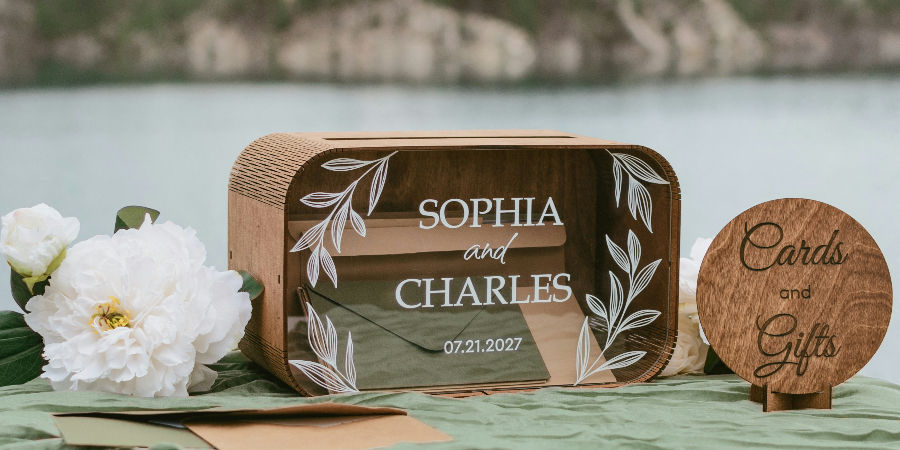
Style and Personalization
A monogram or your names and date on the lid turns a plain wedding card holder into something you'll want photographed on the gift table. It doubles as a display piece during the reception, and a personalized box is more likely to get reused afterward than one that gets recycled.
Personalized boxes usually cost more than plain ones. The upgrade can pay off twice: once when it matches the decor, and again when it comes home with you.
Looking for decorating inspiration? Our post on wedding card box ideas covers what to send in and how to organize it once the cards are collected.
What Happens to Your Wedding Card Box After the Wedding
You bring it home, empty the cards into a drawer to deal with later, and the box goes into a closet. It tends to stay there. Even a beautifully personalized box rarely gets pulled back out once the cards are gone.
That's no knock on the box. It did its job during the reception, and it was built for one day. The question after the wedding becomes how to keep what was inside. Our guide on what to do with wedding cards after the wedding walks through your options once the cards are out of the box.
From Card Box to Keepsake Book
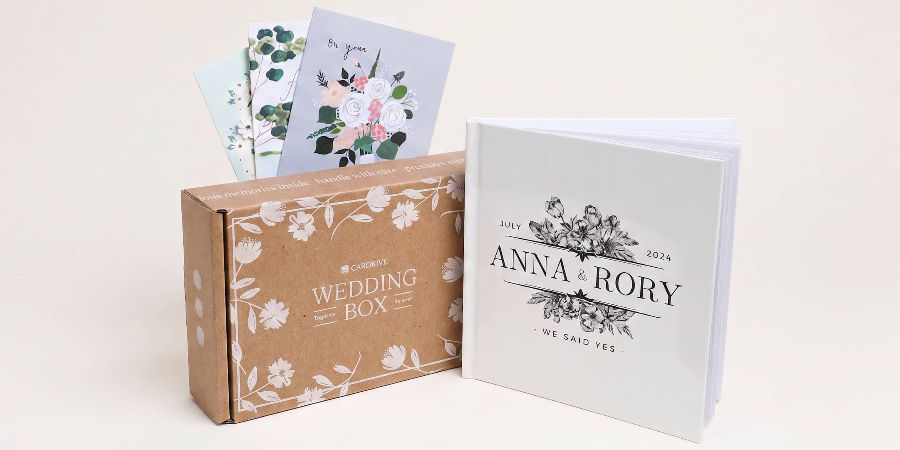
A Cardkive Wedding Cards Book turns your cards into an 8" x 8" hardcover book. You order a sturdy box that arrives with a prepaid label, and shipping for the box and the book is free. Fill it with your wedding and shower cards, and send it back. Our team photographs and edits each card, and you'll review the layout and approve it before anything is printed.
You can also upload up to 20 pages of your own wedding photos at no extra charge, choose a favorite for the cover, and add your invitation, save the date, or menu. The standard Wedding Box holds about 50 cards, and the Double Box holds about 100. If you're weighing a keepsake book against other ways to store cards, see how greeting card albums compare with keepsake books.
Engagement and shower cards can go in the same box. If you're collecting those first, the Engagement & Bridal Shower Cards Book page covers that stage.
One Cardkive customer, Kimberly D Snyder, described her wedding card book this way:
"The book created with our wedding cards is lovely. Each page is perfectly edited, including a 3D card with insert. The process was easy and the team sent the cards back at the end."
If you're still collecting the rest of the paper from the wedding, our guide to wedding invitation keepsakes and save-the-dates covers that part separately.
Wedding Card Box FAQs
What size wedding card box do I need for 100 guests?
Plan for 60 to 90 cards, and check the box's stated card capacity rather than judging by its outer size. If you expect cards from the wedding party and out-of-town family, choose the larger option.
Do I need a wedding card box with a lock?
It isn't required. A locking or latching lid is worth having for outdoor venues, long cocktail hours, or any reception where the box won't be watched the whole time, especially if guests are slipping in gift cards or cash.
What is the best material for a wedding card box?
Wood holds up best to a full reception and the trip home. Acrylic looks elegant but scuffs and cracks more easily, and fabric-wrapped boxes are the lightest but the least likely to be reused later.
Can I use a wedding card box as a keepsake afterward?
Some personalized boxes do get reused as a small keepsake or storage box, but most end up in a closet once the cards come out. A box made for display at the reception isn't designed to hold up as a long-term album, so many couples move the cards into a keepsake book.
What's the difference between a card box and a memory book?
A card box collects cards during the event itself. A memory book, like a Cardkive Wedding Cards Book, is built afterward from the cards you've collected, so you can open it and read them for years instead of storing them away.
A Home for the Cards After the Reception
Whichever box you land on, the cards inside deserve somewhere to live once the day is over. When you're ready, get started with a Cardkive Wedding Cards Book and give them a place on the shelf.


Comments