What to Do With Birthday Cards: The Full Guide to Birthday Card Books
Updated: 3 days ago
Every year, the same names show up in your mailbox around your birthday. Your mom, who never misses one. Your best friend from college, who always finds the perfect pun. Your grandfather, whose handwriting gets a little shakier each year but whose message never changes: proud of you, love you, happy birthday.
You keep every single one. Of course you do. But somewhere around year ten, "keep every single one" turns into a drawer that won't quite close, and you're not sure what to do next.
Birthday cards are a unique category of keepsake. Unlike wedding cards or baby announcements, which arrive once and mark a single moment, birthday cards arrive every year, from the same people, for as long as you're lucky enough to keep celebrating. That's what makes the pile different: it's not just sentimental, it's monumental. A decade of birthdays means a decade of handwriting, inside jokes, and the occasional twenty-dollar bill taped inside the fold.
So what do you do with birthday cards once the drawer won't close?
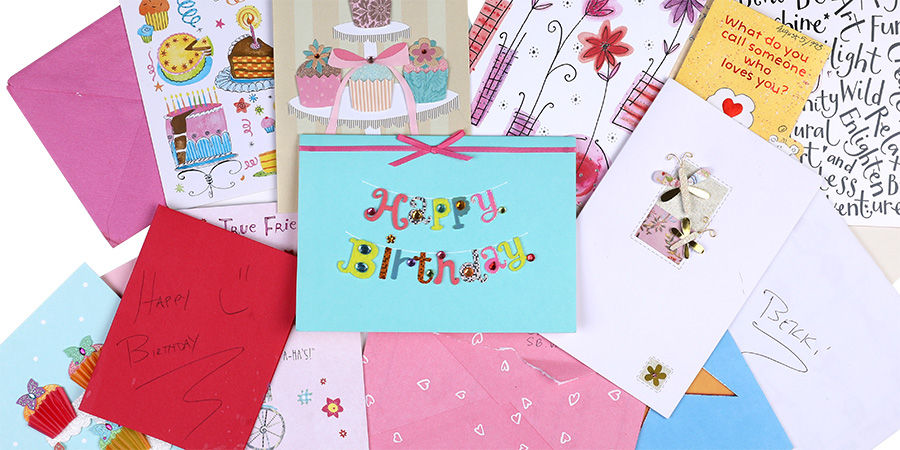
Why Birthday Card Storage Gets Complicated
Most birthday card storage starts simple: a drawer, a shoebox, maybe a decorative tin someone gave you for exactly this purpose. It works fine for the first few years. Then the same drawer that held five cards is holding fifty, and it's no longer storage so much as a place things go to be forgotten.
The problem isn't sentimentality. It's that birthday cards, unlike a lot of other keepsakes, never stop arriving. A box built to hold ten years of cards was never really built to hold thirty. Eventually, most people reach a point where they have to decide whether to keep adding to the pile, thin it out, or find a better and more dependable way to preserve these special birthday cards.
If you're weighing a traditional keepsake box against something more permanent, our comparison of Cardkive versus a keepsake box walks through the tradeoffs of each in more detail.
What to Do with Birthday Cards: Three Approaches
Most people land in one of three camps, and each one comes with real tradeoffs.
Keep everything, exactly as it is. This is the instinct for anyone who can't imagine parting for a seoncd with a card in Grandma's handwriting. And it may work for you now, but eventually one drawer becomes two drawers (or more). More importantly, this method risks cards getting bent, faded, or lost in a move. The sentiment may stay intact, but the organization does not.
Let most of them go. Some people read each card once, smile, and recycle it. This keeps the clutter in check, but why should you have to choose between the funny card from your college roommate and the note from an uncle who's since passed away? And there's no coming back once it's out the door.
Turn the collection into something you'll actually revisit. This is where a lot of people land once the drawer gets full enough to feel like a problem worth solving. A Cardkive book takes the whole collection, captures the front and inside of every card, and turns it into a hardbound keepsake you'd actually pull off a shelf. You get to keep the handwriting, the inside jokes, and the specific way each person signs their name, minus the drawer that never quite shuts.
None of these is the "right" answer. The best one depends on how much you want to hold onto, and how often you actually want to look back at it. In fact, if you're also sitting on a stack of graduation cards or other occasion-specific cards, the same three approaches generally apply.
A birthday memory book, built from years of cards instead of a single occasion, ends up telling a different kind of story than most keepsakes do. Wedding cards capture one day. A birthday memory book captures every year in between, in the handwriting of the same people watching you grow, move, and change.

What Is a Birthday Card Book?
A birthday card book is exactly what it sounds like, and also not quite what people expect the first time they hear the term. It's not a blank journal you fill in yourself, and it's not a pre-printed gift book with someone else's greetings already inside. It's built from cards you already have: the ones that showed up in the mail every year, signed by the same handful of people, saying some version of the same thing in a slightly different way each time.
The difference between a birthday card book and just keeping the cards themselves is what happens to them next. Instead of staying loose in a drawer, each card gets photographed and laid into a bound book, in order, so the whole run of birthdays reads like one continuous story instead of a stack you have to sort through by hand every time you want to see one.
It's an ongoing collection rather than a one-time keepsake. A wedding cards book or a sympathy cards book captures a single occasion. A birthday card book keeps growing every year there's another birthday, which is part of why the next question (how many years actually belong in one book) matters more here than it does for a one-time occasion.
How Many Years of Cards Fit in One Book?
There's no rule that says a birthday card book has to cover someone's entire life, and trying to fit all of it into one volume is usually where people talk themselves out of starting at all. A few different approaches work, depending on how many cards are on hand and how far back they go.

One book per decade is the most common split for anyone with cards going back further than ten or fifteen years. It keeps each volume a manageable size and makes it easy to add a new one later without disturbing what's already finished. A single book covering five to ten years works well for a more recent collection, or for someone who wants to start now and pick up a second volume down the road rather than backfilling everything from childhood.
For a collection large enough to span decades in one go, that's where a Double Cards Book comes in. It holds roughly twice what a standard book does, which matters more for birthday collections than almost any other occasion, since birthdays are the one event that keeps adding a card every single year rather than happening once.
There's no wrong answer here, and the choice can always be revisited later. Starting with whatever's already collected, in one book, is a reasonable place to begin even without a firm plan for how future years get added — and the same decade-based sizing applies just as well if this is a book someone else is putting together as a gift, rather than a project for yourself.

How To Make Cardkive A Milestone Birthday Gift
If you're the type who saves cards, a big birthday - the 30th, the 40th, the 50th - is a natural moment to do something with the collection you've been sitting on. Make a plan to have Cardkive create a milestone book that celebrates and preserves that decade's worth of birthday cards.
This works especially well as a milestone birthday gift that someone else puts together. A partner, a sibling, or a close friend can quietly gather the cards from the last several birthdays (with the birthday person's blessing, or as a surprise) and turn them into a memory book for their milestone year. This kind of gift will land harder than anything you could buy, because it's made from the memories and words of the people they love most.
It also solves a real problem for whoever's doing the gift shopping. Buying a 40th or 50th birthday gift for someone who already has most of what they need gets harder every year. A book of the birthday wishes they've collected over the years sidesteps that problem entirely, because it isn't a new thing; it's what they already have, made easier to hold onto.
A Note on the Cards from People You Miss

Some of the hardest cards to part with, or even look at, are the ones from people who are no longer here. A grandmother's last birthday card. A father's handwriting from years ago. These cards carry more weight than the rest, and there's no wrong way to hold onto them.
If you're not ready to do anything with those cards yet, that's completely fine. When you are, preserving them may be a gentler option. With Cardkive, you have the option to recycle your cards or have them returned if you're not quite ready to part with them. You keep the words and the handwriting without having to decide, right now, what happens to the paper itself.
If this describes a card from someone you've lost specifically, our guide to what to do with sympathy cards covers that situation with more care than we can give it here.
Keep the Cards, Lose the Drawer

You don't have to choose between sentimental and organized. A Cardkive book takes years of birthday wishes, the funny ones, the sweet ones, the ones from people you miss, and turns them into something you'll actually open again. Get your Cardkive book started with the collection you already have.
Still working on what to write in this year's card? Here are 50+ birthday card ideas and messages for every relationship and tone, plus what to do with the card once the candles are out.
Frequently Asked Questions
What is a birthday card book?
A birthday card book is a bound keepsake made from birthday cards you've already received, photographed and laid out in order rather than left loose in a drawer. Unlike a wedding or sympathy cards book, which captures a single occasion, a birthday card book is built to keep growing every year.
How many years of birthday cards should I keep before doing something with them?
There's no rule here. Some people start a book after five years, others wait until a milestone birthday prompts it. If the drawer is full enough that you can't easily find a specific card, that's usually a good signal.
Is it silly to keep birthday cards for years?
Not at all. A birthday card is one of the few keepsakes that captures someone's exact words, in their own handwriting, on a day meant just for you. That's worth holding onto.
What's the best birthday card storage option if I'm not ready to make a book yet?
A simple, sturdy box in a well-placed visible location is the way to go, as opposed to a drawer or shoebox where cards may be physically compromised. Sort loosely by year if you can. It'll make turning it into a book that much easier.
What do I do with cards from people who've passed away?
Keep them as long as you want, at whatever pace feels right. When you're ready, Cardkive can be a helpful resource and lets you keep the message and memory without pressure to make a permanent decision about the physical item. Check out our guide on How to Preserve Sympathy Cards for more insight
How many birthday cards fit in one keepsake book?
A standard Cardkive book can comfortably hold a decade or so of birthday cards. For a collection spanning several decades, you can use the Double Cards Box holds roughly twice as many cards and is often the better fit for a lifetime's worth of birthdays rather than trying to compress everything into our standard volume.


Comments